- Powering the Nation Faster Than Ever
- Call Us:880 1755 626 006

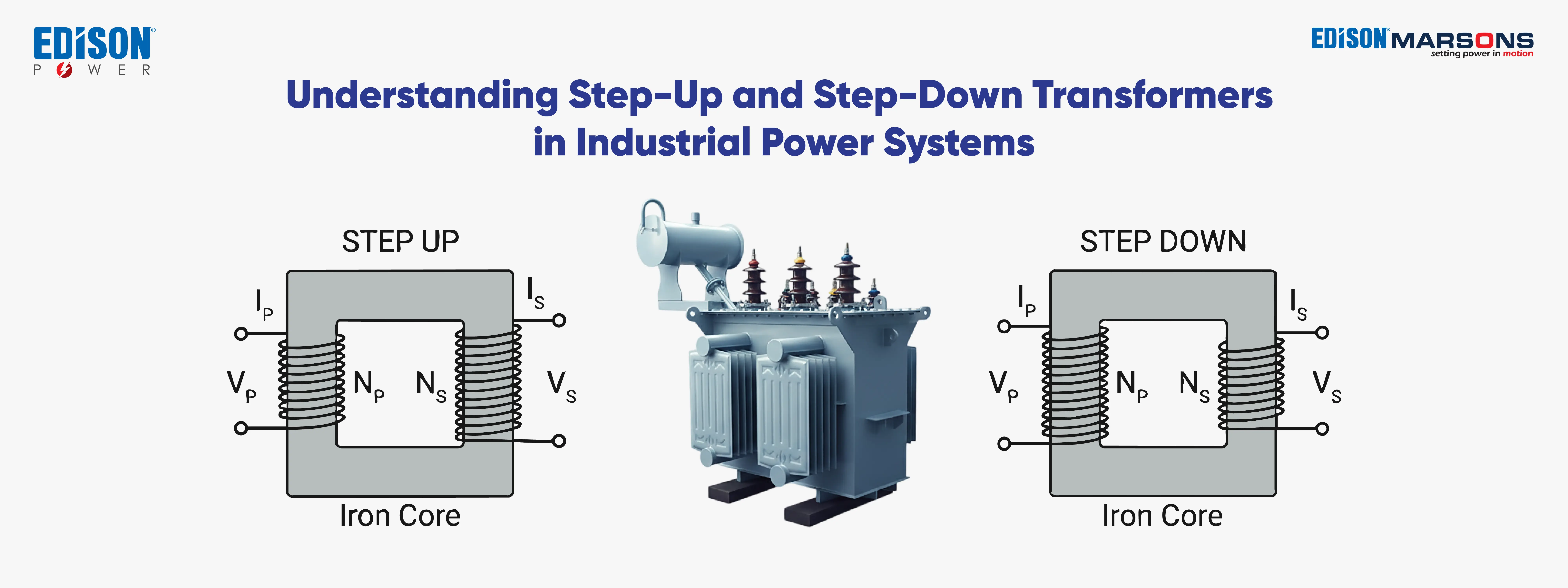
Step Up vs Step Down Transformers in Industrial Power Systems
Voltage control is just as important as power generation itself in any industrial power system. Machines, motors, lighting systems, control panels, and automation equipment etc. require electricity at specific voltage to operate safely. This is where step-up and step-down transformers play different roles.
In Bangladesh’s industrial situation where factories, substations, EPC projects, utility systems etc. face fluctuating grid conditions—understanding how these transformers work is necessary for engineers, facility managers, and project planners. Choosing the right transformer type is a must cause the wrong transformer type can cause energy loss, equipment damage, safety risks, long-term performance degradation etc.This guide explains what step-up and step-down transformers are, how they perform inside industrial power systems, and how to choose the right transformer type for real-world use.
What Is a Step-Up Transformer?
A step-up transformer is a type of transformer which increases voltage from a lower level to a higher level. In industrial power systems, this is commonly done when electricity needs to be transmitted over long distances or connected to high-voltage distribution networks.
When voltage is increased, current decreases for the same power level. This reduction in current minimizes transmission losses. This makes them ideal for efficient power delivery in large industrial projects.
In Bangladesh, step-up transformers are mostly used in:
- Power generation plants
- Industrial plants connected to high-voltage electricity grids
- Reusable energy systems (solar, hybrid plants)
- Substations that deliver electricity into transmission lines
As an example, voltage can be stepped up from 400V or 11kV to 33kV or higher before delivering into a utility.
What Is a Step-Down Transformer?
A step-down transformer does the opposite. It is a type of transformer which reduces voltage from a higher level to a lower level. This is the most common transformer type used inside factories, commercial buildings, institutional facilities etc.
Industrial equipment cannot operate directly on high-voltage supply. Electronic equipment such as motors, production machinaries, lighting systems, control circuits etc. require stable, lower voltages. Step-down transformers deliver electricity reducing voltage without damaging the equipment.
In Bangladesh, step-down transformers are widely used in:
- Manufacturing plants
- Textile and garment factories
- Commercial buildings and malls
- Universities, hospitals, and data centers
- Industrial substations and distribution panels
For example, voltages can be stepped down from 33kV to 11kV. And then for further end-use equipment, it can be reduced to 415V or 230V.
How Step-Up and Step-Down Transformers Work Together
Step-up and step-down transformers are not different units, though they operate individually. work as a part of a voltage transformation chain in industrial power systems.
Electricity may be:
- Generated at a relatively low voltage
- Stepped up for efficient transmission
- Distributed across substations
- Stepped down multiple times before reaching machines
This layered transformation maintains safety & equipment compatibility, and ensures minimal energy loss.
Key Differences Between Step-Up and Step-Down Transformers
However both transformers share similar construction principles but their application and system roles are different.
Voltage Direction
- Step-up transformers increase voltage
- Step-down transformers decrease voltage
Primary Use
- Step-up → transmission and grid connection
- Step-down → equipment operation and distribution
Industrial Placement
- Step-up → near generators or grid connection points
- Step-down → near load centers such as factories and buildings
Risk & Safety
- Step-down transformers require higher safety attention due to proximity to people and machinery
- Step-up transformers usually operate in restricted or controlled zones
Step-Up and Step-Down Transformers in Bangladesh’s Industrial Context
Bangladesh’s industrial power systems are often exposed to:
- Voltage fluctuation
- High humidity
- Dust and heat
- Mixed indoor and outdoor installations
Because of this, transformer selection must consider not only voltage rating but also environment and load behavior.
Dry type transformers are increasingly preferred for step-down applications inside factories and buildings due to their fire safety and low maintenance. Oil type transformers are still widely used for step-up and outdoor high-voltage applications, where cooling efficiency and cost-effectiveness are critical.
Common Industrial Applications
Step-Up Transformers Are Commonly Used For:
- Power plants feeding electricity to the grid
- Solar power plants connecting to distribution networks
- Industrial facilities exporting excess power
- High-voltage substations
Step-Down Transformers Are Commonly Used For:
- Factory machinery and production lines
- Garment and textile mills
- Commercial and residential complexes
- Institutional power distribution
- Industrial control rooms and automation systems
Capacity Selection Matters
Selecting the right transformer capacity is just as important as choosing step-up or step-down configuration.
For example:
- 100–400 kVA transformers are typically used for localized step-down applications in small to medium factories or commercial buildings.
- 1000–1600 kVA transformers are commonly used in large factories, substations, and industrial distribution systems where higher load handling is required.
Overheating & voltage instability can occur after choosing the undersized transformers. On the other hand, oversized transformers increase capital cost and reduce efficiency.
Efficiency and Energy Loss Considerations
Transformer efficiency depends on:
- Core material quality
- Winding design
- Load profile
- Cooling method
Step-up transformers help reduce transmission losses by lowering current, while step-down transformers ensure voltage is safely reduced without excessive heat generation.
In industrial environments, energy loss directly impacts operating cost. Well-designed transformers—especially dry type models for indoor use—help maintain stable voltage with minimal losses.
Safety and Compliance in Industrial Systems
Safety is a major reason why many industrial facilities in Bangladesh are moving toward dry type step-down transformers.
Key safety advantages include:
- No oil leakage or fire risk
- Reduced need for fire barriers
- Lower environmental impact
- Easier compliance with building safety regulations
Oil type transformers still require:
- Fire containment systems
- Oil pits or bund walls
- Regular oil monitoring
Why Understanding Transformer Type Improves System Design
Many electrical failures occur not because of poor equipment quality, but due to incorrect system design. Misusing step-up and step-down transformers—or placing them in unsuitable environments—leads to inefficiency and safety issues.
A well-designed industrial power system uses:
- Step-up transformers for transmission efficiency
- Step-down transformers for operational safety
- Appropriate capacity selection based on load behavior
Stable operation with lower downtime and predictable maintenance costs can be ensured by this approach.
Frequently Asked Question
Q. What is the main difference between step-up and step-down transformers?
A: Step-up transformers increase voltage for power transfer. On the other hand, step-down transformers decrease voltage for safe equipment operation.
Q. Which transformer is more common inside factories?
A: Step-down transformers are more common inside factories because most of the machines operate at lower voltages.
Q. Are step-up transformers used inside buildings?
A: No, Mostly step-up transformers are not used inside buildings.
Q. Which transformer type is safer for indoor industrial use?
A: Dry type step-down transformers are safer for indoor industrial use.
Q. What kVA range is suitable for industrial step-down transformers?
A: 100-400 kVA units are suitable for small to medium industries & for large industries, you can rely on 1000-1600 kVA units.
Q. Can one transformer act as both step-up and step-down?
A: Technically yes, depending on connection, but in industrial systems transformers are designed and dedicated for specific roles.
Final Thoughts
Step-up and step-down transformers aren’t different units. Both are essential in industrial power systems. You should understand how and where each should be used as it allows facilities to operate more fluently. The right transformer selection is necessary for long-term success, especially in developing industrial countries like Bangladesh.